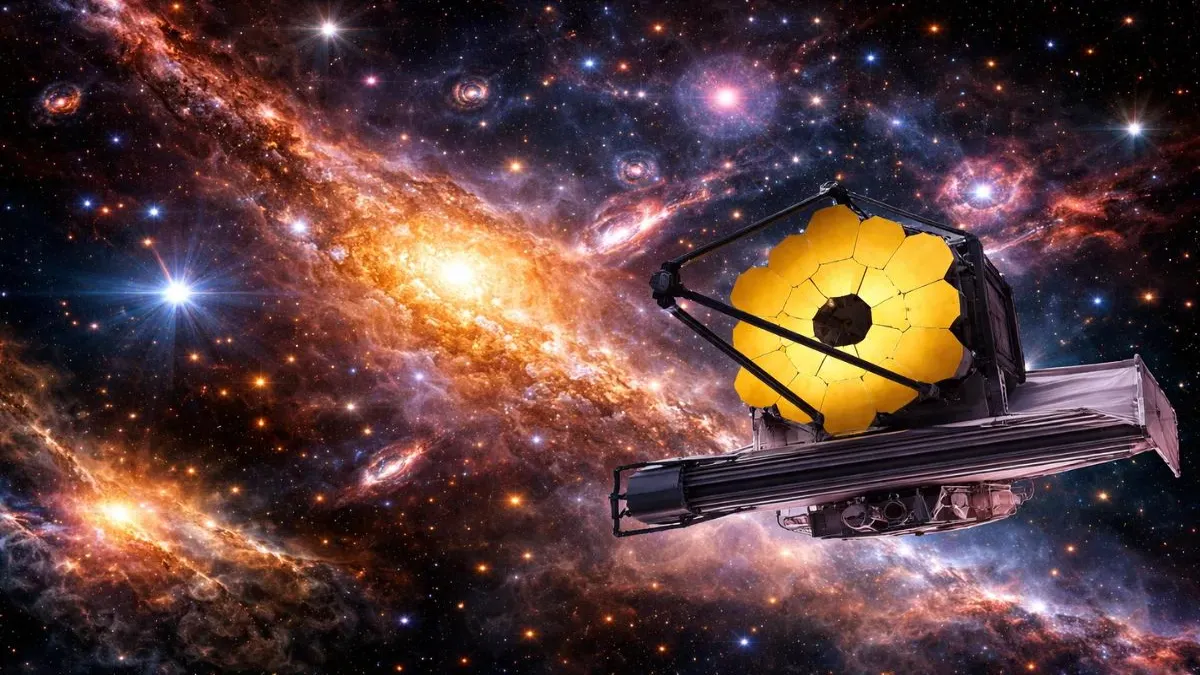
Amazing Space Discoveries Space has fascinated scientists and explorers for generations. Modern telescopes, robotic spacecraft, and advanced scientific instruments are helping researchers investigate distant galaxies, planets, stars, and other cosmic objects.
Every new observation provides opportunities to understand how the universe formed and how different celestial systems work.
The Role of Modern Space Telescopes
Space telescopes observe objects beyond Earth’s atmosphere. This allows scientists to collect information across different wavelengths of light without many of the disturbances caused by the atmosphere.
The James Webb Space Telescope is an important example. It uses infrared observations to study distant galaxies, stars, and planetary systems.
What Scientists Study in Space
Distant Galaxies: Researchers examine galaxies to understand their structures and evolution.
Exoplanets: These are planets located outside our solar system. Scientists study their atmospheres and physical characteristics.
Black Holes: Astronomers investigate these extremely dense objects and their effects on surrounding matter.
Star Formation: Observations of gas and dust clouds help scientists understand how stars develop.
Important Areas of Space Research
| Research Area | Main Purpose |
|---|---|
| Exoplanets | Study planets beyond our solar system |
| Black Holes | Understand extreme gravity |
| Galaxies | Explore cosmic evolution |
| Stars | Investigate stellar life cycles |
| Planetary Science | Study planets and moons |
Why Space Research Matters
Space research contributes to scientific knowledge and can support developments in imaging, communication, materials, and other technologies.
Satellite systems also support weather forecasting, navigation, and environmental monitoring.
Future Possibilities
Future missions may provide more detailed observations of distant worlds and help scientists investigate questions about planetary environments.
However, discovering evidence of life beyond Earth remains an open scientific question.
Conclusion
Space exploration continues to expand human understanding of the universe. Modern scientific instruments are helping researchers investigate questions that were once impossible to study in detail.
1. What is an exoplanet?
An exoplanet is a planet that orbits a star outside our solar system.
2. What does the James Webb Space Telescope study?
It observes distant galaxies, stars, planetary systems, and other cosmic objects.
3. Why do scientists study black holes?
They help researchers investigate gravity, matter, and extreme physical conditions.
4. Have scientists confirmed life beyond Earth?
No confirmed evidence of extraterrestrial life has been established.